Most Whirlpool dishwashers that leave water in the tub have a partial blockage somewhere along the drain path. That path runs from the filter and sump at the bottom of the tub, through the drain hose, to the sink drain, air gap or garbage disposal. Whirlpool’s own support page lists a clogged filter, debris in the sump, a kinked or blocked hose, a problem at the disposal or sink connection, or a jammed drain pump as the frequent causes. The first few are usually checks an owner can do, in the order below.
This guide follows Whirlpool’s published support content. Filter design, controls and error codes vary by model, so use your owner’s manual for anything specific to your machine.
First, check whether there is really a problem
Some water in the bottom of the tub is normal, so rule out these cases first.
- A little water around the filter. Whirlpool says it is normal to see a small amount of water in the filter area, about halfway up the filter area. Water well above the filter, or near the door opening, is the sign of a drainage problem.
- An unfinished cycle. A cycle that was paused or interrupted may not have reached its drain stage. Whether and how you can resume depends on your model. One Whirlpool owner’s manual (part W10903644) tells owners to confirm the cycle has finished, and describes resuming with Start/Resume. Check your own manual before copying that step.
- Too many suds. Whirlpool says dish soap causes over-sudsing. If you see suds, turn the dishwasher off and let them dissipate. Use only detergent made for automatic dishwashers from now on.
- A code on the display. See the error code section further down.
Before you start: safety
- Turn off power at the circuit breaker. Whirlpool says not to rely on the control panel alone.
- Shut off the water supply at the under-sink valve.
- Stop and call a qualified technician if you smell burning, see damaged wiring, or the breaker trips repeatedly.
- If the dishwasher is hard-wired and you aren’t comfortable removing panels, book service instead.
- Don’t pour drain-opening chemicals into the dishwasher.
How to fix a Whirlpool dishwasher that won’t drain
Step 1: Remove the standing water
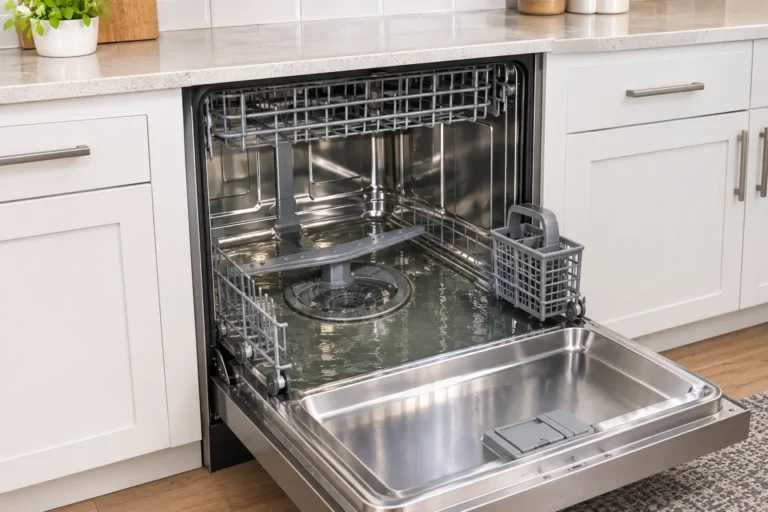
Put towels in front of the dishwasher. Bail out the water with a cup into a bucket. Then lift the rest out of the sump, the recessed well near the filter, with a turkey baster or hand pump. This makes the filter and hoses easier to inspect and cuts the risk of spills.
Step 2: Clean the filter and check the sump
- Remove the lower rack.
- Twist the upper filter counterclockwise and lift it out. Lift out the lower filter too if your model has one.
- Rinse both under warm water and scrub gently with a soft brush. Avoid abrasive pads.
- Use a flashlight to look in the sump for food, labels, seeds, toothpicks or glass, and remove what you find.
- Seat the lower filter flat and turn the upper filter clockwise until it is fully engaged. A loose filter can let debris reach the pump.
Many Whirlpool models use this arrangement, but not all. If your filter looks different, follow your manual. Whirlpool’s owner’s manual (W10903644) recommends cleaning both filters at least once a month and warns against wire brushes and scouring pads, which can damage them.
Step 2 result check
Run a short rinse cycle and listen for the drain pump. If the water drains, the filter was the cause. If not, continue.
Step 3: Check the garbage disposal and knockout plug
If your dishwasher drains through a garbage disposal (a food waste disposer), a blocked disposal can stop it draining.
- Run the disposal to clear any food in it.
- If the disposal was recently installed or replaced, check that the knockout plug in its dishwasher inlet was removed. Whirlpool says a plug left in place blocks drainage completely and calls removing it critical. The disposal’s own installation instructions show how.
Step 4: Check the drain hose, high loop and air gap
- Look for damage along the hose. Check under the sink, and behind the toe panel only if you’re comfortable removing it with power and water off. You’re looking for kinks, crushing or sagging.
- Check the high loop or air gap. Whirlpool says the hose should form a high loop secured under the counter, or connect to a clear, working air gap. Without one of these, wastewater can flow back into the tub.
- Clean the air gap, if you have one. It sits on the sink. Remove the cap and clear debris from inside and under it, following the air gap maker’s instructions.
- Check the connection. Put a towel and pan underneath, loosen the clamp and detach the hose from the disposal or sink tailpiece. Look at the hose end and the inlet for debris.
- Flush the hose. Use warm water from a tap or garden hose. For a stubborn clog, use a flexible plastic line or dishwasher-safe brush. Avoid sharp tools, which can puncture the hose.
- Reattach it. Tighten the clamp snugly without overtightening, then check the sink tailpiece and trap for buildup.
Step 5: Run a short cycle and watch
Run a short cycle and check whether water remains. If water spills from the air gap, Whirlpool says the blockage is further along, in the hose-to-drain path or the sink plumbing.
What your symptoms may point to
This table follows Whirlpool’s diagnostic clues. It shows possible causes, not a confirmed diagnosis.
| What you notice | What it may mean | What to do |
| Water slightly above the filter screen | Partial restriction in the filter, sump or hose | Steps 2 and 4 |
| Water near the door opening | Severe blockage or a pump that isn’t running | Check the hose and disposal plug (Steps 3–4), then listen for the pump |
| Hum, but no water movement | Jammed impeller (the part inside the pump that moves water) | Check the sump for debris. Don’t dismantle the pump. Book service if it persists |
| Grinding noise | Hard debris, such as glass, near the pump | Check the sump. Book service if it persists |
| Water backs up from the air gap | Blockage downstream of the dishwasher | Clear the hose and sink plumbing |
| No pump sound during the drain stage | Electrical or control fault | Stop here and call service |
A pump or control fault is possible, but only after the filter, hose and sink connection are clear. iFixit’s Whirlpool guide makes the same point: replace the pump only after ruling out obstructions.
Error codes and resetting the control
Don’t assume a code means the same thing on every model. Whirlpool’s F9E1 page lists “Long Drain” as the potential cause. It points to the same checks as above: filter, hose, disposal, air gap and suds. The page doesn’t name the models it covers, so confirm against your owner’s manual.
That page also describes a power cycle: disconnect the dishwasher from power for 30 seconds. If it’s plugged in, unplug it and plug it back in. If it’s hard-wired, switch its breaker off for 30 seconds, then on again. This is a reset of the control. It won’t clear a physical blockage.
The owner’s manual I checked (W10903644) lists no draining-specific code. Whirlpool’s main “not draining” page says to check an error code against your model’s user guide. If your manual doesn’t list the code, contact Whirlpool service.
New dishwasher or recent plumbing work
If the problem started after installation or a plumbing job, Whirlpool’s newly installed dishwasher page points to setup details first:
- the disposal knockout plug
- a kinked, pinched or crushed hose
- hose length, routing and height that don’t match the installation instructions
- a missing or low high loop or air gap, which local codes may require
- a loose clamp
Whirlpool gives no measurements on that page. Use the installation guide supplied with your dishwasher and your local plumbing code for the exact figures.
When to stop and call service
Contact Whirlpool or a qualified appliance technician if:
- draining doesn’t improve after you clear the filter and hose
- you smell burning, see damaged wiring, or the breaker keeps tripping
- water leaks, or the code isn’t in your manual
- the pump doesn’t run, hums without moving water, or grinds
- you suspect the pump, valve, wiring or control board is at fault
Whirlpool’s page lists a US customer service number, 1-866-698-2538, and a service scheduling link. Also check your model number against official recall notices, such as the US CPSC recall list. If a recall applies, follow its exact instructions.
Keep it draining
- Scrape plates before loading.
- Clean the filter regularly, and more often if you wash a lot.
- Keep the high loop intact after under-sink work or disposal replacement.
- Run hot water at the sink before you start a cycle.
- Use only dishwasher detergent, never dish soap.
If you’re outside North America
Whirlpool’s support pages above are US-focused, and drain connections differ by country. Check the installation instructions and local plumbing rules for your region. The UK consumer group Which? gives similar first steps in its guide to a dishwasher that won’t drain. It says to switch the machine off at the mains and clean the filters first, and to check the waste hose for kinks or squashing.
Sources: Whirlpool Product Help: Dishwasher Not Draining · Newly Installed Dishwasher Not Draining · Water Remain at End of Cycle · F9E1 · Whirlpool owner’s manual W10903644 · iFixit · Which? · CPSC recalls