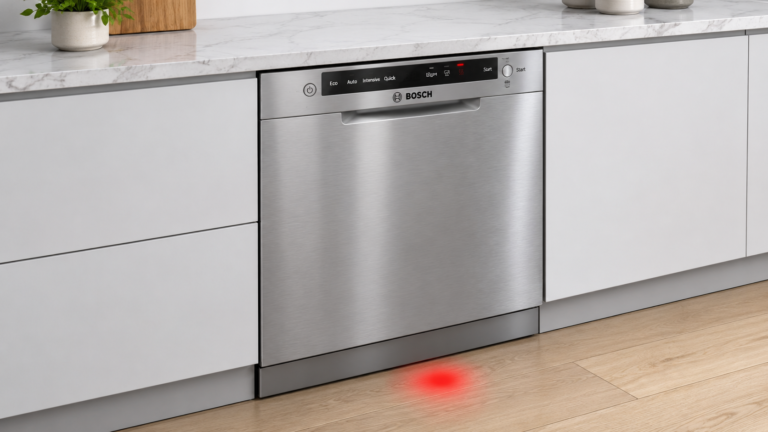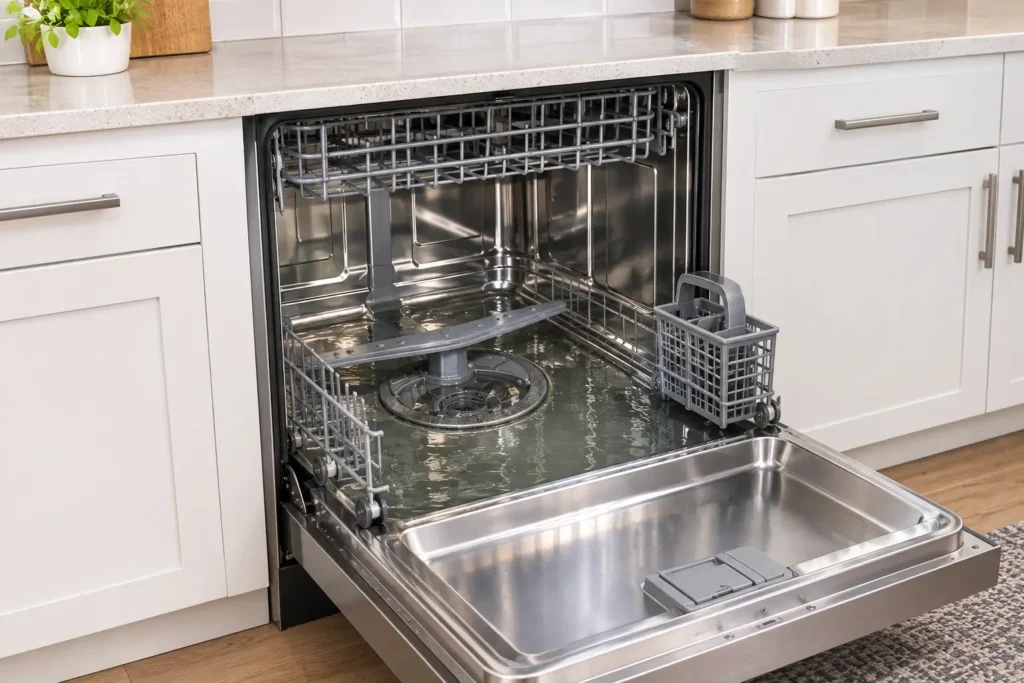
If your Frigidaire dishwasher is not draining, start with the simplest causes. Check whether the cycle finished, whether the garbage disposal knockout plug was removed, whether the filter is clogged, and whether the drain hose is kinked. Most of these checks take a few minutes and need no tools. If none of them helps, the cause is likely a failed pump, a damaged hose or a control fault, which is a job for a service technician.
This guide covers Frigidaire dishwashers in general. Frigidaire’s own troubleshooting pages don’t list specific models, so your model’s manual always comes first. The label inside the door frame or tub edge shows your model number.
Before you start
- Switch the dishwasher off at the circuit breaker before reaching into the tub or under the sink. Unplugging alone may not remove every electrical hazard.
- Don’t pull the dishwasher out of its cabinet, open its panels, or test or replace the pump or electronics yourself. Those jobs belong to a technician.
- Filters can trap broken glass and sharp items. Handle them carefully.
- Water mid-cycle is normal. Frigidaire’s manuals describe a cycle as a series of fills and drains, so water is only a problem if it is still there after the cycle has ended.
Work through these checks in order
Frigidaire’s official “not draining” article lists the main causes. The steps below follow its order and add a few general checks.
1. Did the cycle finish?
Stopping a cycle partway, without pressing Start/Cancel, stops the dishwasher from completing the cycle and draining. Restart the cycle so it can finish, or press Cancel. The Frigidaire FAQ also says to confirm the cycle is complete and not paused.
2. Is it newly installed, or connected to a garbage disposal?
If the unit is new, Frigidaire says to confirm the drain hose was installed correctly.
If the dishwasher drains into a garbage disposal, check that the knockout plug was removed from the disposal’s dishwasher inlet. A new disposal has a plug that blocks the inlet until someone knocks it out. If it is still in place, the water has nowhere to go. Frigidaire lists this as a check in its not-draining article and in the quick reference guides that come with its dishwashers.
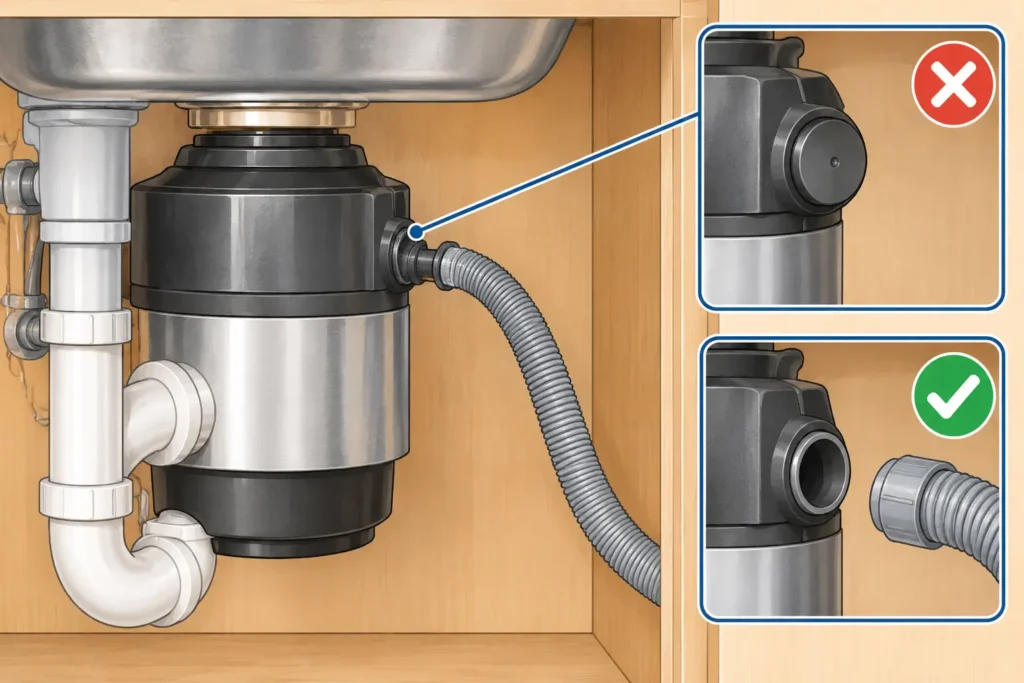
Removing the plug means working inside the disposal, so confirm with the installer or follow the installation instructions. Don’t reach into a disposal that could be switched on.
3. Are the glass trap and filters clogged?
A clogged filter can cause drainage problems, and Frigidaire’s filter guide shows how to clean them. Switch off the power at the breaker first, then:
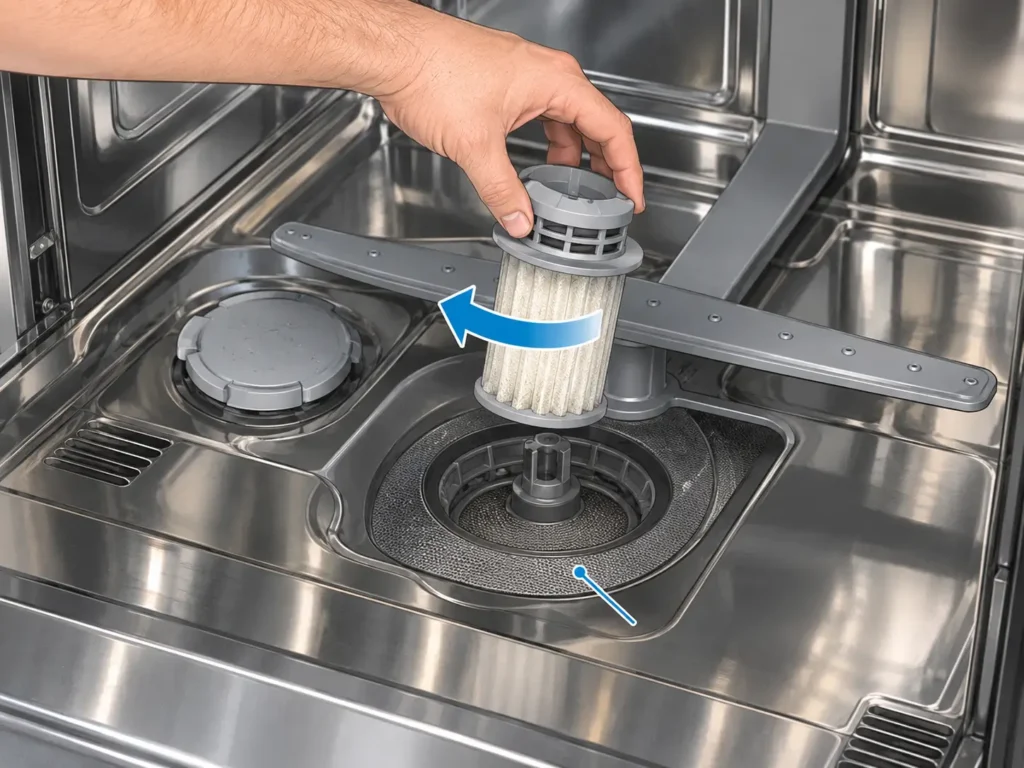
- Scoop out any standing water with a cup, then mop up the rest with a towel.
- Remove the cylinder fine filter by turning it counterclockwise and lifting it out.
- Lift out the coarse filter from the tub bottom, hold it under running water, and put it back.
- Empty and rinse the cylinder fine filter. Use a sponge or bottle brush if residue remains, then reinstall it.
The layout varies by model. Some models have a separate glass trap built into the spray arm, so follow your own manual’s care and cleaning pages. Use only water and a sponge or brush, as Frigidaire describes. Don’t use cleaning products that your manual doesn’t recommend for the filter.
Some Frigidaire quick reference guides recommend cleaning the glass trap monthly. That advice appears in guides for specific models, so check whether yours says the same.
4. Is the drain hose kinked, pinched or too low?
A kink in the drain line can cause drainage problems or leave water pooled in the bottom after the cycle. Frigidaire’s drain hose guide covers this. A hose can be bumped or moved after something is stored under the sink.
Look under the sink for kinks or crushed sections, but only where the hose is easy to see. Don’t pull the dishwasher forward to inspect it.
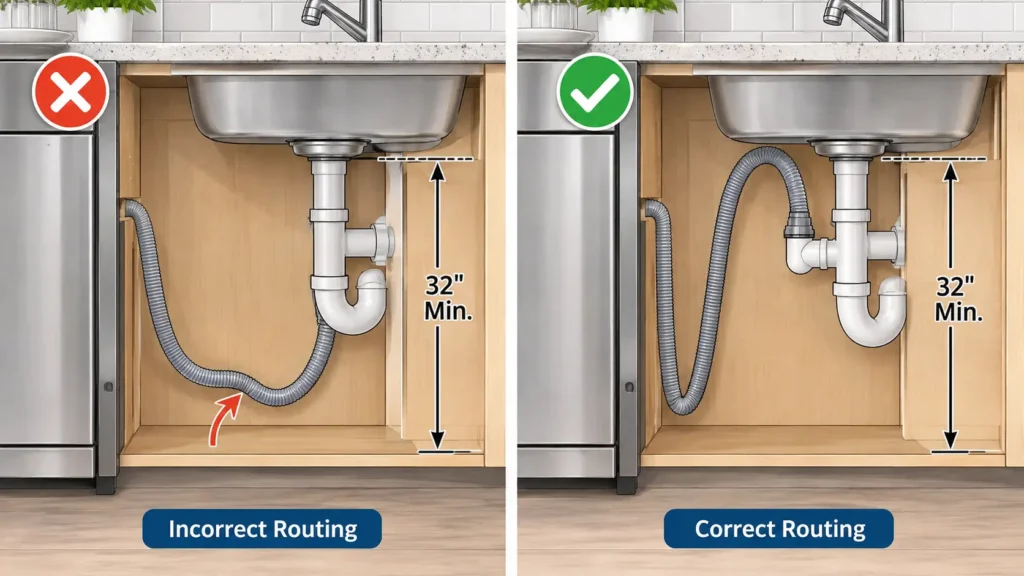
Frigidaire’s error code guide also says the drain hose should be at least 32 inches above the floor. Built-in dishwashers are normally connected either through an air gap or through a raised loop in the hose. If the loop is too low or was never installed, ask your installer or a plumber to correct it.
5. Is the sink drain or disposal blocked?
Frigidaire’s article doesn’t list this, but it is a common general cause. The dishwasher drains into the same plumbing as your sink, so a blocked sink drain or disposal can stop it. If the sink is slow or backs up, clear that first. Repair-service guidance also lists a sink drain clog as a check.
6. Does your installation have an air gap?
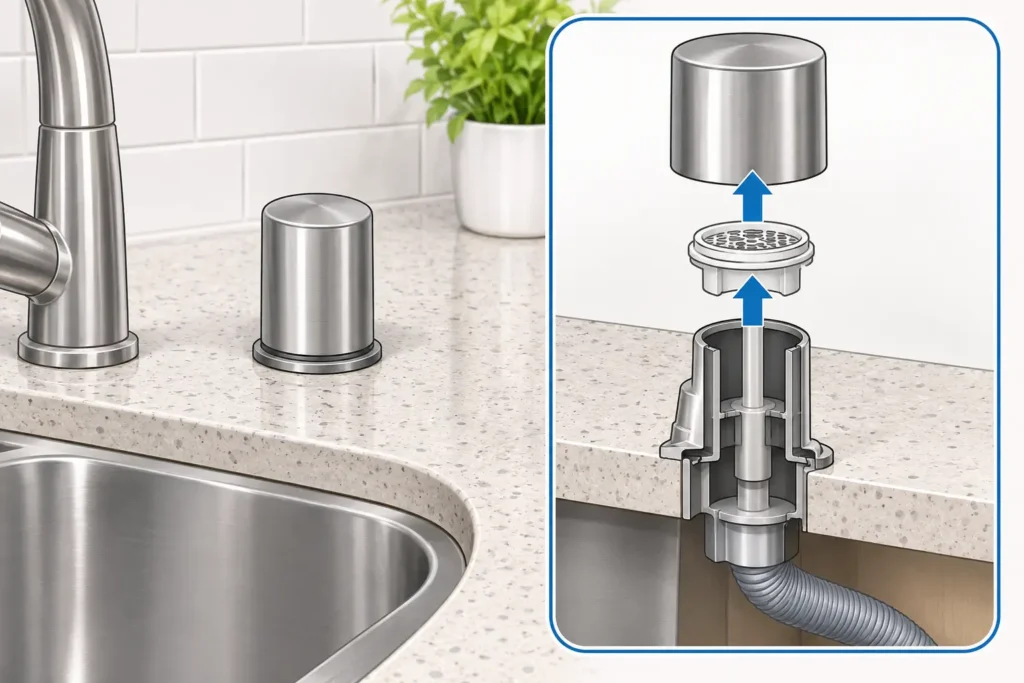
Some built-in installations have a small air gap fitting on the countertop. If yours does, remove the cover, lift out the filter, empty it, rinse it and replace it. The air gap is not part of the dishwasher and is not covered by the warranty.
What the i20 and i40 codes mean
Many Frigidaire dishwashers show a code when they detect a drain problem. The codes below come from Frigidaire’s general dishwasher guides, which don’t name models. Check your own manual’s code table, because codes can differ between models.
- i20: unit did not drain completely. Frigidaire’s error code guide says to check that the disposal knockout plug was removed, that the drain hose isn’t blocked, kinked or pinched, and that the hose sits at least 32 inches above the floor. It also says to clear food residue from the filters and sump. To reset, press Cancel, turn the power off at the breaker, or unplug the dishwasher for 3 minutes.
- i40: clogged filter or sump. Per Frigidaire, food residue has built up in the sump. Clean the glass trap and filter, then run the dishwasher again. If the code returns, contact support.
At least one Frigidaire owner’s guide, for the FDSP4501AS, groups i20, i40 and iF0 as clogged filters or a restricted drain line. Don’t assume that applies to your model.
A reset only clears the code. If the cause is still there, the code will come back.
When the cause is likely the pump or electronics
If you have cleared the filters, straightened the hose, confirmed the disposal plug is out and checked the sink, and the water is still there, stop. Repair-service sources commonly list a failed drain pump, a cracked drain hose or a faulty control board as the usual causes at that point. Diagnosing them means working with live electrics and water, and tests or part replacements are not something to attempt on your own.
Stop using the dishwasher and call a qualified technician or Frigidaire if you notice any of these:
- Burning smells, smoke or sparks
- Water leaking near electrical parts
- A breaker that trips repeatedly
If there is smoke or fire, leave the area and call emergency services.
Who to contact
Frigidaire’s article gives a simple rule based on installation date:
- Installed within the past 30 days: contact your installer.
- Installed more than 30 days ago: contact Frigidaire to schedule service.
Have your model and serial numbers ready. You can reach support through Frigidaire’s owner support pages. Also check Frigidaire’s recall information page if your unit shows any safety-related fault.
The Userbook is an independent publisher and is not affiliated with Frigidaire. Frigidaire is a trademark of its owner. If you spot an error, tell us at hello@theuserbook.com.
Sources
- Dishwashers – Not Draining, Frigidaire
- What can I do if my dishwasher is not draining?, Frigidaire Canada
- Dishwasher Glass Trap and Filter Guide, Frigidaire
- Dishwasher – Drain Hose Guide, Frigidaire
- Dishwasher Error Codes and Alarms Guide, Frigidaire
- Dishwasher Error Code i40, Frigidaire
- Sears Home Services: Frigidaire dishwasher won’t drain